The freedom story Henry “Box” Brown brought to Brighton
In July 1856, Henry “Box” Brown brought the story of American slavery into Brighton Town Hall. He used painted scenes and personal testimony to confront an audience with a system he had survived.
Follow Brown’s journey to Brighton
- Brown’s wife and children are sold and taken away from Richmond.
- Brown escapes from Richmond to Philadelphia inside a wooden shipping crate.
- After the United States passes the Fugitive Slave Act, Brown leaves for Britain.
- Brown presents his anti-slavery performance at Brighton Town Hall.

Brown had survived slavery in Virginia, lost his family when they were sold away and escaped inside a wooden shipping crate. Brighton audiences encountered an abolitionist who had turned that experience into a visual campaign against slavery.
His appearance placed Brighton within a network of British towns where formerly enslaved people spoke for themselves and asked the public to listen.
The loss behind the famous escape
Henry Brown was born enslaved in Louisa County, Virginia, in about 1815. As a teenager, an enslaver sent him to work in a tobacco factory in Richmond.
Brown married and had children, but slavery gave him no legal power to protect his family. In 1848, his wife and children were sold and taken away from Richmond. Brown could not stop the sale and never succeeded in reuniting with them.
Retellings often begin with the ingenuity of Brown’s escape, leaving the destruction of his family in the background. His journey towards freedom grew from a system that had already taken those closest to him.
In March 1849, Brown put a plan into action with the help of James Caesar Anthony Smith, a free Black man, and Samuel Smith, a white shoemaker.
They placed Brown inside a wooden crate measuring about three feet long, two feet wide and two-and-a-half feet deep. The box had several air holes and carried the instruction “This Side Up With Care”.
Express companies transported it from Richmond to Philadelphia, sometimes leaving Brown upside down. After a journey of about 27 hours, members of the Pennsylvania Anti-Slavery Society opened the crate. Brown emerged into freedom.
Taking control of his story
The escape made Brown known on both sides of the Atlantic. He adopted the name Henry “Box” Brown and began speaking at anti-slavery meetings.
His public work also exposed him to danger. The United States Congress passed the Fugitive Slave Act in 1850, strengthening the machinery used to capture people who had escaped slavery, including those living in free states. Brown left for Britain later that year.
He did not rely on speeches alone. Working with the painter and abolitionist Josiah Wolcott, Brown created Mirror of Slavery , a moving panorama made up of 49 painted scenes.
A long painted canvas moved between rollers while a narrator explained the changing pictures. Brown used this popular Victorian form to depict slavery, his escape and the suffering inflicted upon enslaved people.
The National Library of Wales describes the device as something like a moving picture book or an animation storyboard. Brown stood beside those images as someone who had lived through the system they represented.
Selling the story to British audiences
Brown took Mirror of Slavery to towns across Britain. Printed advertisements promoted the panorama alongside the extraordinary story of his escape, using spectacle to attract audiences to an anti-slavery presentation.
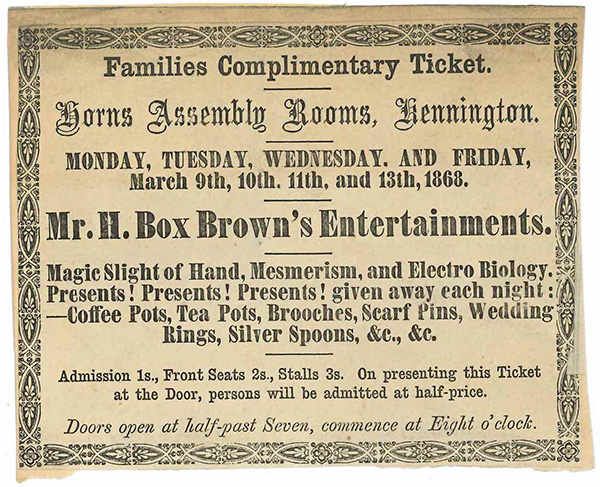 View the advertisement at full size
The poster helps us understand how audiences may have first encountered Brown: through bold publicity that turned his escape, his body and his history into the selling points of a public show.
That publicity created a tension Brown faced throughout his career. The dramatic box journey drew people through the door, yet his panorama asked them to confront the violence, family separation and loss produced by slavery.
Henry “Box” Brown reaches Brighton
Modern research by Martha J. Cutter identifies a substantial review of Brown’s performance in the Brighton Gazette of 31 July 1856.
According to Cutter’s study, Brown presented material from Mirror of Slavery alongside illustrated scenes connected with Uncle Tom’s Cabin. He also told the audience about his escape. The newspaper treated his personal testimony as truthful and praised the panorama’s depiction of slavery.
This account places Brown at Brighton Town Hall during the summer of 1856. The Town Hall served as a centre of civic life, but its rooms also hosted public lectures, concerts and performances. Brown used that prominent local space to speak about freedom, family separation and racial violence in the United States.
His audience did not encounter slavery through a British campaigner speaking on somebody else’s behalf. Brown presented his experience in his own voice and through images he had helped bring to the stage.
Brighton’s divided relationship with slavery
By the time Brown came to Brighton, Britain had abolished slavery across most of its Caribbean colonies. Parliament passed the Slavery Abolition Act in 1833, with emancipation taking effect from 1834, followed by a period of forced “apprenticeship”.
Abolition did not erase Britain’s responsibility for slavery or the wealth it produced. People with Brighton and Sussex connections had owned, inherited or held financial interests in Caribbean estates where people were enslaved. Compensation went to slaveholders and other claimants after abolition. The people who had endured slavery received nothing.
Our investigation of Sussex’s connections with British slavery shows how money, property and family relationships tied the county to estates across the Caribbean.
Brighton also had a history of anti-slavery campaigning. Public meetings, petitions and visiting speakers gave local residents opportunities to support abolition. Some people campaigned against slavery while others benefited from the wealth and legal structures it had created. Brown entered that local landscape as a survivor, campaigner and artist.
More than the man in the box
Brown continued to reshape his performances during his years in Britain. He worked as an actor, magician, mesmerist and entertainer, combining different forms of theatre with stories about slavery and escape.
Audiences and promoters sometimes reduced him to the spectacle of a man climbing out of a crate. Brown found ways to support himself, hold public attention and retain control over how people encountered his past.
His performances could contain uncomfortable contradictions. Victorian advertising sometimes drew on racial stereotypes, while Brown experimented with theatrical identities that modern audiences may find troubling. Cutter’s research warns that stories about him were embellished and reinvented during his lifetime and after his death.
Brown was a man building a life after slavery while working within the opportunities and prejudices of nineteenth-century entertainment.
Why his Brighton appearance matters
Henry “Box” Brown’s visit changes how we see Brighton Town Hall. In 1856, it became a stage on which a self-emancipated Black American described slavery to a local audience.
Freedom did not restore the family taken from him. Nor did it free Brown from racism or financial uncertainty. He had to create a new public life from experiences that other people often wanted to package as spectacle.
The panorama gave him one way to do that. Through painted scenes and his own testimony, Brown made himself the narrator of a history in which enslaved people were too often recorded only as property.
For Brighton, the performance created a direct connection with Black abolitionist activism. A global struggle entered a local civic building, carried there by a man who had escaped slavery and claimed the right to tell audiences what it meant.
Sources and further reading
- Henry Box Brown, Narrative of the Life of Henry Box Brown, Written by Himself , Manchester: Lee and Glynn, 1851.
- Martha J. Cutter, The Many Resurrections of Henry Box Brown , University of Pennsylvania Press, 2022.
- National Library of Wales, “Henry Box Brown: Escaping slavery and introducing Crankies to Wales”.
- Jeffrey Ruggles, The Unboxing of Henry Brown , Library of Virginia, 2003.
- Brighton Gazette , 31 July 1856, review of Henry “Box” Brown’s performance, cited and discussed by Martha J. Cutter.
- Brighton Gazette collection, British Newspaper Archive.