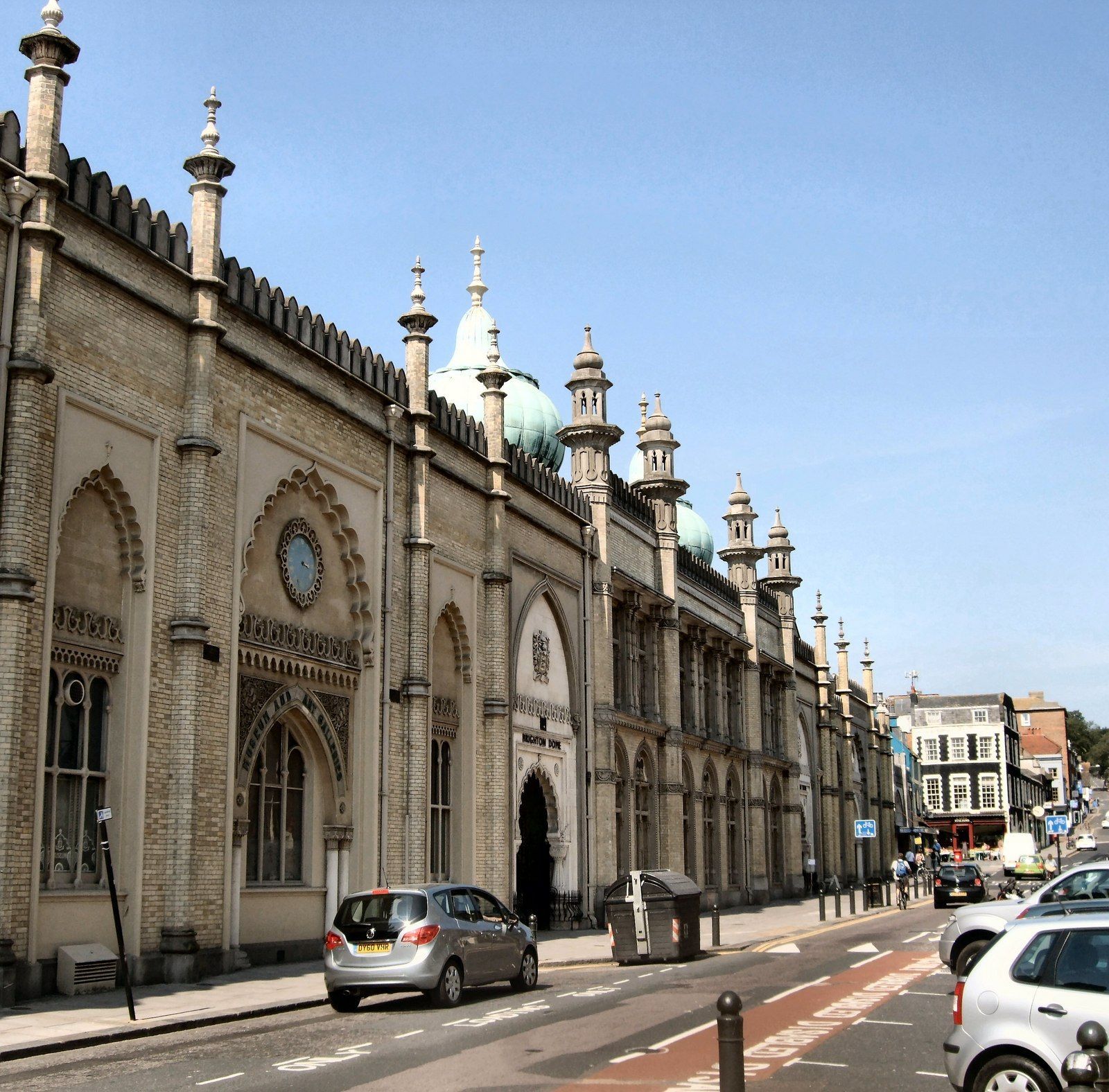
Five encores had not been enough. On a Sunday afternoon in April 1938, Paul Robeson's audience at Brighton Dome was still asking for more. Before he could leave, they wanted to hear Ol' Man River, the song so closely associated with him.
The Brighton and Hove Gazette's account, published on 30 April, preserves an unusually detailed glimpse of that concert. Alongside the applause were songs from Spain, a partnership with pianist Lawrence Brown and a reviewer who wished that more of Brighton had come to listen.
A Brighton audience already knew him
Robeson had performed in Brighton years before this afternoon at the Dome. Historian Christian Hogsbjerg's research reproduces an Eastbourne Gazette report of 15 May 1929 which said hundreds of people had been turned away from his recital at Brighton Hippodrome.
That report places Brighton within the seaside concert tours through which Robeson built a British following. His local story reaches beyond one appearance or one building.
Brighton Dome's heritage account records appearances beginning in 1936 as part of Harold Holt's International Celebrity Concert Series. Robeson joined a programme of visiting artists that also included Richard Tauber and Wilhelm Furtwängler.
He was already a singer and actor with an international reputation. In Brighton, his appearances belong within a longer history of Black performers, including the Southern Syncopated Orchestra's residency in 1921.
Two musicians on the Dome stage
The 1938 review describes a programme crossing several musical traditions. Alongside spirituals were Russian songs, Shenandoah and Gershwin's It Ain't Necessarily So.
Brown accompanied Robeson and joined him in singing spirituals. His contribution deserves attention alongside the famous name on the bill. The New York Public Library's archive identifies him as a composer, pianist and arranger, and records a working partnership with Robeson lasting thirty-eight years.
Their Brighton appearance gives that long collaboration a local setting. What the audience heard depended on both musicians.
Songs from Spain
The reviewer also recorded two Spanish war songs, sung with a verse in Spanish and a verse in English. These placed a contemporary conflict within the afternoon's music.
Earlier that year, Robeson had travelled to Spain in support of the Spanish Republic during the civil war. The International Brigade Memorial Trust preserves accounts of his singing for volunteers in January 1938. Their recollections describe the encouragement his performance gave them before they went to the front.
For those in the Dome, music from Spain sat alongside spirituals and familiar theatre songs. Robeson's public commitments could be heard within the music he chose to perform.
Applause and empty seats
The warmth of the response did not mean a full house. The same reviewer who described repeated demands for encores regretted the many vacant seats.
The review records a strong response among those present while leaving the size of the audience in perspective. It gives no explanation for the empty seats.
Our wider account of
Brighton Dome and Mandela Hall explores places where music and political life met. This cutting brings us closer to a particular afternoon: Robeson and Brown performing, songs from several countries, and listeners still calling for another song when the advertised programme was over.
Robeson's Sussex performances continue to be remembered. On 25 October 2026, a plaque was unveiled at Eastbourne's Winter Garden, where he had also performed. The commemoration is a timely reminder of the wider Sussex concert history to which his Brighton appearances belong.
Read the newspaper review
The Brighton and Hove Gazette published its review, “Paul Robeson's Visit: Audience Clamour for More”, on 30 April 1938, page 5. Read the original newspaper review in the scan shared through Christian Hogsbjerg's research.
Sources
Christian Hogsbjerg: Paul Robeson in Eastbourne, 23 January 2021. Includes the Brighton cutting and a transcription from the Eastbourne Gazette, 15 May 1929.
Brighton Dome: Heritage Stories, Entertainment.
New York Public Library: Lawrence Brown papers.
International Brigade Memorial Trust: Paul Robeson and the International Brigades, 14 April 2021.
Banner: Brighton Dome, photographed in 2011 by Paul Gillett / Geograph. Cropped for the banner. CC BY-SA 2.0: https://creativecommons.org/licenses/by-sa/2.0/