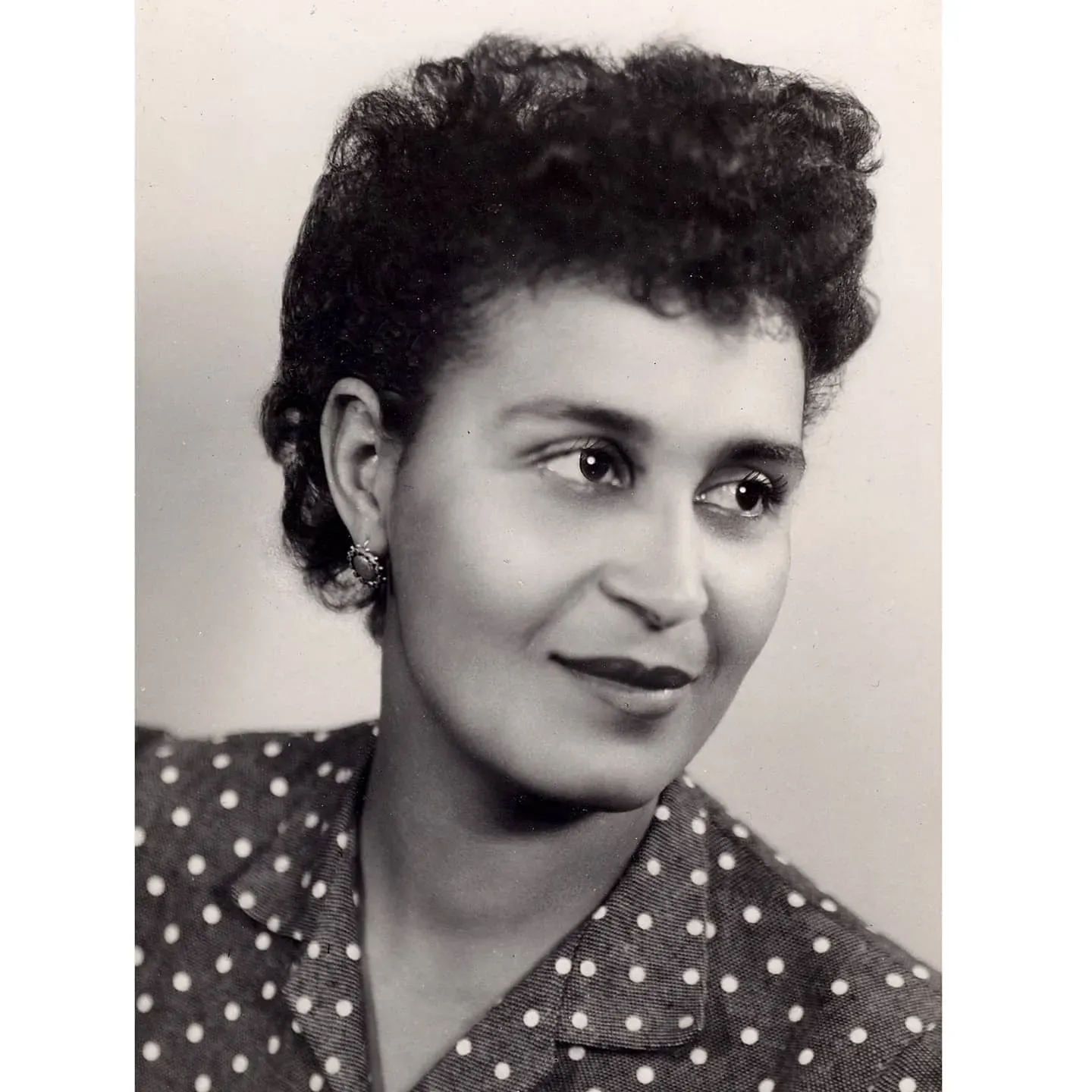
The eldest granddaughter of
Emperor Haile Selassie of Ethiopia. Born in 1927, she was the daughter of Ras Desta Damtew and Princess Tenagnework, Haile Selassie’s eldest daughter. Her baptismal name was Bisrate Gabriel.
When Italy invaded Ethiopia in 1936, Aida and her family went into exile. Her father, Ras Desta Damtew, led resistance in the south but was captured and executed by the Italians in 1937. Aida, then aged 10, was among the imperial women and children who left for England.
Aida Desta in England
Aida spent five years in England, from around 1936 to 1941. She attended schools in Cornwall and Wales.
- At St Clare School in Penzance, Cornwall, her grandfather Haile Selassie visited her.
- She later studied at Clarendon School for Girls in north Wales.
- In 1945 she matriculated at Newnham College, Cambridge, to study history.
Her time in England was shaped by exile and loss. The Italian occupation had taken her father and her homeland. Yet she received a British education that prepared her for leadership.
The St Paul’s Church plaque
Aida Desta’s link to Brighton is marked by a plaque in St Paul’s Church, West Street.
- In 1947 Haile Selassie donated money to repair the church tower.
- The plaque thanks him “for the five years spent in England by his granddaughter Princess Aida Desta”.
The inscription reads:
“THIS PLAQUE COMMEMORATES A GENEROUS GIFT TOWARDS THE REPAIRS TO THE TOWER OF THIS CHURCH IN 1947 BY H.I.M. HAILE SELASSIE EMPEROR OF ETHIOPIA AS A MARK OF APPRECIATION FOR THE FIVE YEARS SPENT IN ENGLAND BY HIS GRANDDAUGHTER PRINCESS AIDA DESTA”
This suggests Aida had some connection to St Paul’s, perhaps attending services or having friends there.
Aida’s later life
Aida returned to Ethiopia and married Leul Ras Mengesha Seyoum, Prince of Tigray, in 1949. They had six children. She was active in charity and culture, serving as president of the Ethiopian Women’s Welfare Association.
In 1974 the Derg regime arrested her. She spent 14 years in prison, sharing a cell with other imperial women, including her mother and aunts. Released in 1988, she lived in exile, splitting time between Washington DC and Addis Ababa. She died in Virginia in 2013, aged 85.
Why Aida Desta’s story matters
Princess Aida Desta’s plaque in St Paul’s Church gives Brighton a quiet link to Ethiopia’s imperial family.
It shows:
- Imperial women and children lived in Britain during the 1930s.
- Haile Selassie’s family left traces in churches and schools across England.
- Aida’s five years here prepared her for later leadership and exile.
The plaque sits in West Street, near the seafront. It marks thanks for British hospitality during a time of loss. Aida Desta’s name reminds us that even in a south coast church, Ethiopia’s history reached Brighton.
You can also listen to the podcast about her life and exile
here.
Aida was not the only African woman of royal lineage whose story touches Brighton. Sarah Forbes Bonetta
was married here in 1862 after years as a ward of Queen Victoria, a Yoruba woman at the centre of one of the most watched events Brighton had ever seen. And in Hove in 1892,
Princess Victoria Ka'iulani of Hawaii
was quietly preparing for a future that empire had already decided. These three stories, across three continents, all leave a trace on the same stretch of the English coast.